
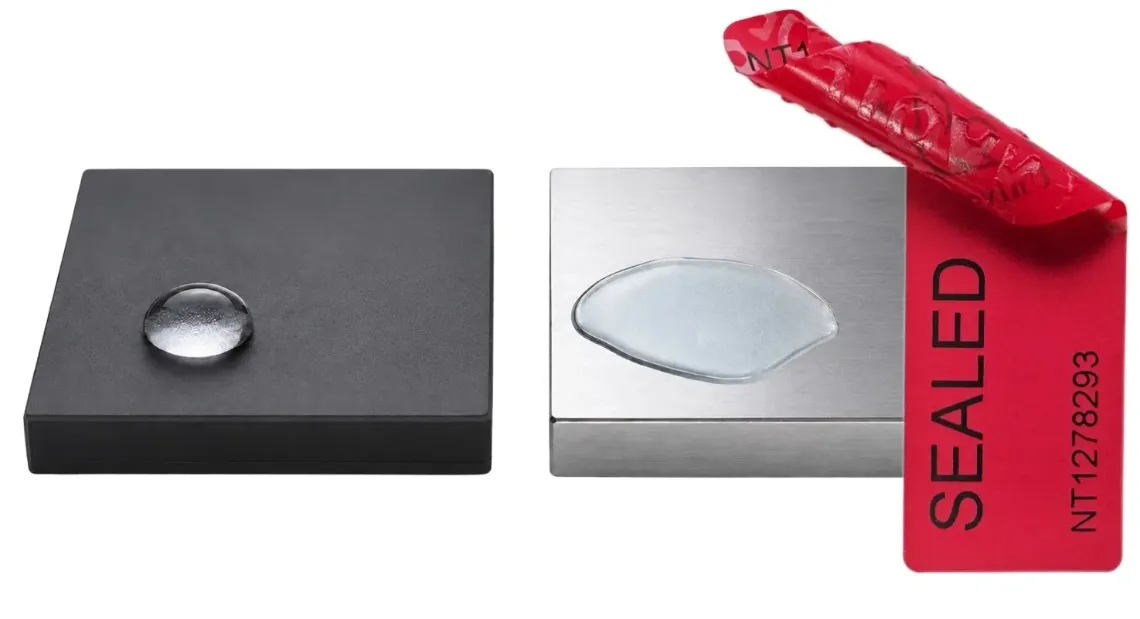
When using a tamper-evident tape or security label, you need to be sure that the adhesive technology in use will adhere and void properly in all circumstances. This sometimes poses challenge - one tamper-evident material may adhere perfectly and securely to one surface, but lifts away surprisingly easily from another. This can happen even when the surfaces look and feel similar... so what's going on? The crucial difference is often due to the concept of 'surface energy'.
What is surface energy?
In short, surface energy describes how readily the molecules on a surface of a material interacts both with itself and with other molecules, such as liquid or adhesives. This affects how readily an adhesive can spread across, or “wet out”, a surface. It is particularly important for tamper-evident security labels, because the adhesive must establish a sufficiently secure bond for the VOID, transfer or destructible mechanism to activate correctly.
In adhesive applications, a higher-energy surface generally allows the adhesive to spread more easily and establish close contact. A lower-energy surface is more inclined to resist that interaction.
Tamper-evident Technology & Surface energy: Quick answer
Higher-energy surfaces are generally easier to bond. Low-surface-energy plastics such as polyethylene and polypropylene can be more challenging and may require a specialist adhesive. Cleanliness, texture, temperature, pressure and dwell time also affect the final result.
What does 'wet-out' mean?
“Wet-out” describes how well a liquid like a pressure-sensitive adhesive spreads across and conforms to the application surface. Although the adhesive appears solid, application pressure helps it flow into microscopic irregularities and create a larger effective contact area. Good wet-out does not automatically guarantee a successful security application, but poor wet-out can prevent the label from developing enough surface contact for its tamper mechanism to work consistently.
How a water droplet provide a useful guide
A simple water-drop check can provide a quick visual indication on a smooth, non-porous surface:
- Choose a representative area of the actual application surface.
- Place a small droplet of clean water on it.
- Observe whether the droplet spreads or forms a pronounced bead.
- Compare the result with other known surfaces where helpful.
A flatter droplet suggests better wetting. Strong beading may indicate a lower-energy or contaminated surface. An inconsistent result across the same item may point to variations in the finish or surface cleanliness.
Better wetting
A flatter, spreading droplet suggests that the surface is easier to wet.
Poorer wetting
A pronounced bead suggests a lower-energy or potentially contaminated surface.
Use this as an indication, not an approval test
The result can be influenced by contamination, texture, coatings and temperature. It is also unsuitable for porous materials such as paper and cardboard, where water absorption can obscure the result. Testing the actual security material on the production surface remains essential.
Why adhesion matters to tamper evidence
An ordinary product label principally needs to remain attached. A security label has an additional job: it must produce a visible and preferably irreversible indication when removal is attempted.
Depending on its construction, it may leave a VOID message on the protected item, reveal a message within the label, separate into layers or break into fragments. These effects rely on a controlled relationship between the adhesive, the label construction and the application surface.
If the surface bond is too weak, the complete label may lift before its tamper mechanism activates. The label may appear faulty when the underlying problem is poor surface contact or an unsuitable adhesive.
| Surface type | Typical examples | General bonding behaviour |
|---|---|---|
| Higher surface energy | Glass, stainless steel, aluminium and some polar plastics like nylon | Usually easier for adhesives to wet out and bond |
| Medium or variable | Painted metals, ABS, cardboard and coated materials | Performance depends heavily on the finish, texture and adhesive |
| Lower surface energy | Polyethylene, polypropylene and some non-stick or silicone-treated surfaces | More difficult to wet out and may require a specialist adhesive |
These are broad categories rather than guarantees. An adhesive bonds to the surface it actually touches—not necessarily the material underneath. Paint, powder coating, varnish, mould-release agents and other treatments can therefore change the behaviour of the base material.
How surface contact affects different security materials
Different security constructions need the adhesive bond to behave in different ways:
| Security material | Intended tamper response | Effect of a weak surface bond |
|---|---|---|
| Residue security labels | Leave a VOID, OPEN or transfer message on the protected item | The complete label may lift before the transfer layer separates |
| No-residue security labels | Reveal a message within the label without leaving sticky residue | The internal VOID mechanism may not activate reliably |
| Destructible vinyl labels | Break into fragments when removal is attempted | The label may peel away in one piece rather than fragmenting |
| Residue security tape | Transfers a visible security message along a sealed surface | Transfer may be incomplete or inconsistent across the seal |
Security tape can be particularly demanding because one length may cross printed board, an unprinted panel and a carton seam. Differences across those areas can affect both adhesion and the consistency of the transferred message.
What else affects security label adhesion?
Surface energy is important, but it should be considered alongside the following practical factors:
- Cleanliness: dust, oil, condensation, fingerprints and mould-release agents can prevent direct adhesive contact.
- Texture: an adhesive initially touches only the highest points of a rough surface, reducing the effective bonding area.
- Coatings: printing inks, varnishes, wax treatments, paint and powder coating can behave differently from the material beneath them.
- Temperature: many pressure-sensitive adhesives become firmer when cold and may not wet out readily during application.
- Application pressure: firm, even pressure across the complete label helps develop contact, particularly at its edges.
- Dwell time: the bond can continue developing after application, so an immediate peel test may not represent later performance.
- Curves: labels wrapped around small diameters experience a continuous lifting force at their edges.
Cardboard is especially variable. Recycled fibres, dust, printing, protective coatings and the strength of the outer paper layer can all influence the result. In some cases, removal pulls away carton fibres rather than producing a clean VOID transfer. This may still provide visible evidence of interference, but it is a different tamper response.
How should an application be tested?
For an unusual or security-critical application, testing should use the exact production surface rather than a generic sample of the same material.
- Apply the label to a clean, representative surface using firm, even pressure.
- Test at the lowest expected application temperature where relevant.
- Allow a realistic dwell period before attempting removal (ideally 24 hours if possible).
- Expose samples to expected storage or service conditions.
- Remove at different speeds and angles.
- Check whether the intended VOID, residue or fragmentation effect is clear and difficult to conceal.
The assessment should consider the complete tamper response—not simply whether the label feels sticky or is difficult to peel.
Choosing the right security label or tape
The strongest adhesive is not automatically the best choice. A very aggressive construction may be unsuitable for a delicate or reusable surface, while a clean-removal adhesive may be inappropriate where permanent residue is required.
The correct material must balance initial tack, developed adhesion, surface compatibility, temperature, flexibility and the required tamper response. Universeal supplies specialist adhesive formulations and bespoke security constructions for more challenging plastics, coatings, textures and operating conditions.
Need help matching a security material to your surface?
Tell us about the substrate, application conditions and required tamper response. We can help identify suitable materials and provide samples for assessment.
View security labels View security tapes Discuss your application